
The term ‘Black Magic’ conjures up all sorts of images. Maybe you visualise a terrible ritual, with blood and a Baphomet and some poor victim pinned to the center of a pentagram. Then again, maybe you picture Faust, begging the stars to stand still so that the devil Mephistopheles won’t drag him to Hell. Or perhaps you conjure a witch, huddling over some loathsome doll as she stabs it full of pins.
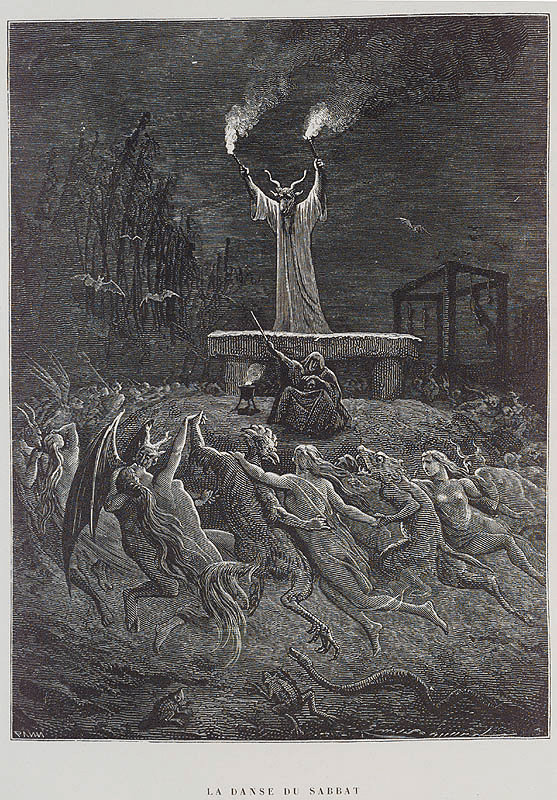
All good options.
But what about the term, ‘black magic’? Where does it come from, and how should we understand it? It might surprise you to discover that, originally, what we know of as ‘black’ magic has nothing to do with a colour whatsoever. It stems from ancient Greek understandings of the supernatural. For example, the suffix -mancy that you might recognise from the fancy words for divination (cartomancy – tarot cards; oneiromancy – interpreting dreams) comes from the Greek manteia. Manteia means ‘divination.’ Now, the creepiest, darkest and most sinister form of divination that we generally think of is necromancy (not to be confused with the… ah… more amorous one). Necromancy combines the Greek root nekros (meaning corpse) with the suffix, –mancy. It thus defines the act of exhuming dead bodies and, through magic, causing them to make prophecies. Essentially, it’s divination through chatting with a corpse.
Lovely.
Medieval Latin, however, got a bit perplexed. In the Middle Ages, the Greek nekros was corrupted and confused with the Latin niger, meaning ‘black’. This Latin term is incredibly common and was used to describe the colour of objects such as soot or coal, or anything else that is literally black. It was a completely neutral term at the time, but I must acknowledge that it is the Latin root of the hideous racial slur that I shan’t quote here. This racialisation of the Latin has caused some of the slippage in our understanding of black magic, creating its more harmful racial connotations nowadays. I am in no way making connections between race and concepts of evil in this blog.
So. Nekros (corpse) became niger (black), which means necromancy (divination with the dead) became nigromancy (the black art of divination). (I must emphasise again that I’m discussing an early shift in language. This stage in European history occurred before the trafficking of enslaved Africans to America. At this point, it was not a racialised term.)
Black magic then became maleficium, which meant the causing of harm through magical means. You might recognise maleficium as being related to words we still use, like ‘malevolent’. It then got applied to the actions of evil sorcerers, but eventually focused on witches. The eagle-eyed amongst you have probably drawn an accurate parallel between maleficium and the late medieval text, the Malleus Maleficarum. This book was also known as the Hexenhammer, or ‘the hammer of the witches.’
And no, it doesn’t mean a witch’s DIY tool. Rather, it is the means through which one might smite witches to smithereens.
But the difference between high magic, low magic and the danger of the medieval witch is a post for another time. For now, it’s enough to remember that when discussing black magic, we’re really talking about conversations with a corpse.
So until my next post, dear reader: stay safe. Stick to tarot cards, and leave the dead where they lie.
Bibliography:
Witchcraft in the Middle Ages by Jeffrey Burton Russell (especially p.9).
Research Notes
Why on earth is she talking about Black Magic?
Well, I’m a Gothic scholar. I’m also researching my novel, which includes medieval witchcraft, vampires and revenants. Not all of the information will make its way into my novel, or my academic articles.
It is, however, fascinating. And since the entire point of Literature Unlocked is to make academic research accessible to those outside the Ivory Tower, I have decided to turn these pieces of information into fun, dark little blog posts.
Enjoy!
 Literature Unlocked
Leave a comment