
Quite the surreal experience, attending a law conference.
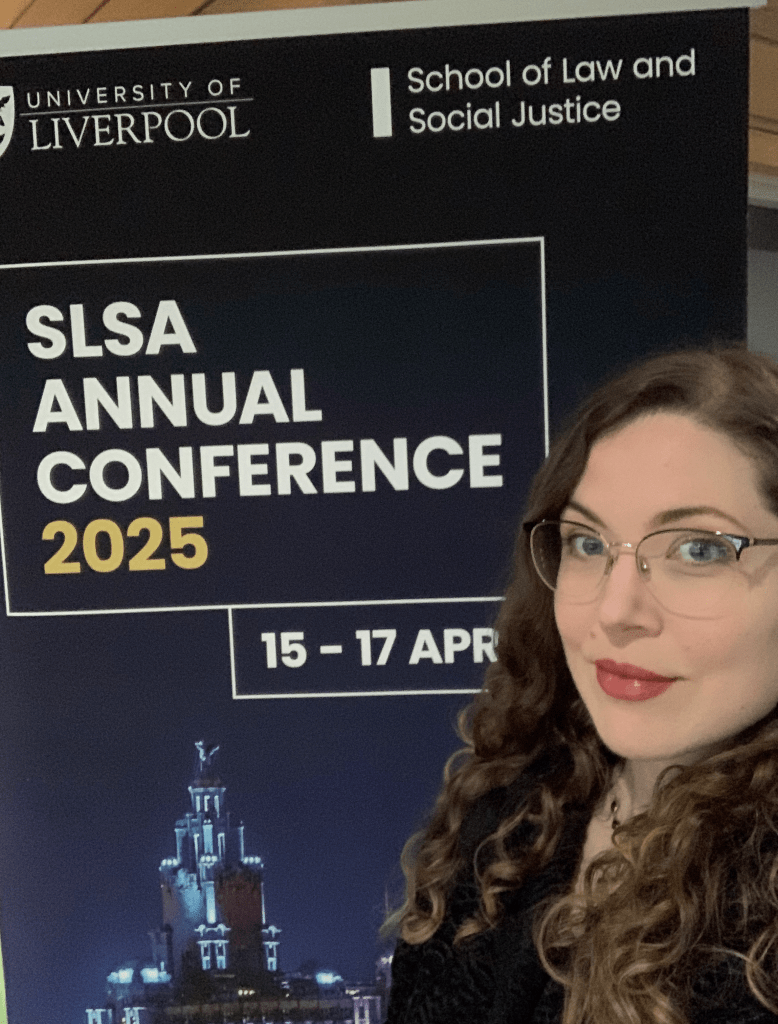
I presented a paper which was a collaboration with Dr Hannah Baumeister.
(We became friends after I worked as her research assistant on the Drawing on Forced Marriage: Teaching Tough Topics Through Comics project.)
Our paper (‘Fatal Words of Consent’: On Marriage and the Law in Wilkie Collins’s The Woman in White) was presented on the ‘Law, Literature and the Humanities’ stream of the Socio-Legal Studies Association Conference.
I was a little anxious about attending a law conference. For one, it was huge. There were so many panels and streams and presenters! For two, it’s a little out of my jurisdiction. The law? Like, lawyers? Friends, I write about monsters. I was convinced no one was gonna let me sit with them at lunch.
Turns out, law academics are a remarkably kind and welcoming bunch. I never felt alienated, and people offered clarification or explanations as I needed them. Presenters were also remarkably patient with my ‘general population’ style questions at the end of panels.
(Happily, I was able to karmically return the favour, as the conference was located on my home turf. The room allocations on the schedule could get chaotic, so I spent a few breaks showing guests around.)
And the panels were so diverse! I learned about grief-tech, as well as the ethics of time dilation in space law. I was fascinated by the concept of Land as death pedagogy, presented by a Diné speaker. As a death-positive individual, I was horrified to discover the hidden misogyny in assisted death practices. Attending opened my eyes to so much, and I left with a lot of inspiration for future creative writing projects. It also gave me a newfound respect for these academics, who deal with distressing, real-world issues daily and don’t lose their minds.
I’ve been plagued by Deep Thoughts ever since.
This year, the Arts and Humanities have taken a massive hit. There have been funding cuts, job losses and general despair not only across the UK, but around the globe. On Wednesday, while trotting between buildings to make my next panel, I received an email on my phone. I’m a subscriber to a medievalism newsletter, and the email was their cry for help. Trump’s cuts has severed them from their funding, and their publishing house was going to go under without subscriber donations. It was a sobering email to receive, juxtaposed against the backdrop of culturally-accepted social sciences.
Job security is non-existent in academia (or at least, as rare as the white hart in a medieval romance). It’s getting worse in the Humanities. But attending this conference, I realised that the Arts have a vital and necessary place in the world. Yes, the SLSA academics are training the lawyers and the law academics of tomorrow, and those people are going to alter the structures of our society. But who are they? How easily do they empathise? Can they think flexibly around a situation, acknowledging the nuances? Apparently, this is increasingly difficult for the social sciences and STEM topics to teach.
But one of the panelists discussed how she included Indigenous art in her teaching of Copyright Law. Her students were forced to consider illustrations and works of art in their assessment, and the experience made them deeply uncomfortable. One student opined in their feedback that they were more comfortable with a rigid structure: case law, plus precedent, equals decision (…or whatever. Sorry law folk, I’m not good at the terminology). Being confronted with a piece of art forced the student to think, to ‘make up their own mind.’
This is not a typical module. It is rare that the arts are taught alongside the law. This confrontation with independent thought will not be a common experience for law students.
And I’ll be honest, that really frightened me. Art and Humanities students and academics live in the Grey Area. We feast upon nuance. Hopefully, we thrive on empathy. These are core skills that are apparently withering on the more culturally-acceptable vines. Globally, people are struggling with media literacy and self-expression as loneliness and isolation feed into culture wars.
Arts and Humanities will go a long way to helping these issues. And yet they’re having their funding cut? It’s disturbing. It’s dystopian. And I will not have it.
I have become even more determined to specialise in outreach, as universities call public engagement. I want everyone to be able to access the empathy of identifying with a character. The discomfort of the grey area. To hone their skills of decision making, argument constructing, and eloquent communication.
All of which can be achieved through engagement with literature.
Soon, I’ll be launching my seminar-style book clubs and creative writing workshops. I’m so excited to take the Humanties into the field.
Because it’s outside of the university that academia can do the most good.
Don’t you think?
 Literature Unlocked
Leave a comment